Growing Guides
Interested in your own edible landscaping, but not sure where to start? We’ve got you covered! Here you will find tons of helpful hints for growing the plants available for pickup at our nursery.
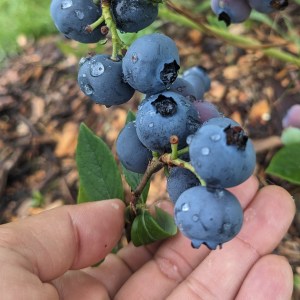
Who doesn’t love a good blueberry? No, seriously, does such a person even exist? Blueberries hardly need any introduction, but they are a berry rich in flavor and antioxidants and native to our region wherever naturally-occuring highly acidic soil is found. Although there are many species of blueberries out there (and blueberry relatives and look-alikes like huckleberries), the mainstay of blueberry production in our region is the Northern Highbush Blueberry (Vaccinium corymbosum). Most cultivars get anywhere from 4 to 6 ft tall, but wild highbush blueberries can reach as tall as 15 ft.
Blueberries do best in full sun and absolutely love rich soil with loads of organic matter and moist but well-drained soil. But the one thing blueberries absolutely must have is a soil pH of 4.0 to 5.5, which means they need very acidic soil. Around our area, soils are more typically around 6.5 in pH, but the best way to know for sure is to do a soil test and send it into the Penn State Soil Lab or a similar university soil testing service like Rutgers, UMass, etc. It’s easy and cheap to do, and it will tell you exactly what your soil pH is. If your soil is above 5.5 like the vast majority of us, you will need to amend the soil with elemental sulfur in order to get the soil pH where it needs to be. Elemental sulfur is just pure, naturally-occurring sulfur, so it’s safe and approved for organic use. Application rates will be found on the back of most bags, but you can also use a soil acidifier calculator to figure out how much you need to add. I can pretty much guarantee that if your soil is not below 5.5 pH and you DON’T add sulfur, your blueberries will never thrive and never produce large amounts of berries, so don’t skip this step!
One other thing you will want to watch out for is the dreaded spotted wing drosophila (SWD), a fruit fly that lays eggs in soft berries like blueberries. The only way to deal with this pest organically is to only plant early or early-mid season cultivars that produce their fruit before the SWD populations are extremely high later in the season. For this reason, we only carry early blueberry cultivars in our nursery and we don’t recommend any late season blueberries for our area. Blueberries are not self-fertile, so make sure you get at least two cultivars for pollination.
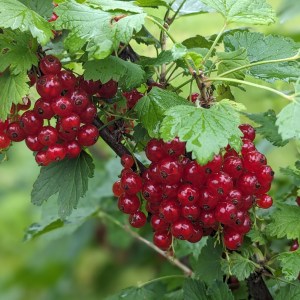
We’re crazy about currants and gooseberries here at Hundred Fruit Farm! We were first introduced to these berries while living in Sweden, where almost every yard had a currant bush or two. Being resistant to deer and having very little pest problems, they thrive equally well here as they did in Sweden. Red, white, and pink currants are all the same species (Ribes rubrum) and have the same growth habits, growing to about 3-5 ft tall and wide. Black currants (Ribes nigrum) are a separate species, growing slightly taller at 3-6 ft tall. Red/white currants are better for fresh eating, but black currants have a more complex flavor. Gooseberries are similar to currants, but the plants have thorns and produce much larger berries, with a more grape-like flavor and texture. All currants and gooseberries are excellent for juices, pies, jams, jellies, drinks, etc.
All currants and gooseberries are self-fertile, but they are so good it’s hard to limit yourself to just one plant! Currants and gooseberries love partial shade to full sun. They seem to thrive best in moist, rich garden soil with a tiny bit of shade, but we also have mulched rows of currants doing very well on our farm out in 100% full sun. They enjoy moist soil but like most berries won’t tolerate consistently wet conditions. They are quite deer resistant, as they are among the last plants deer will choose to eat, but it’s a good idea to protect very young and small plants until they can establish themselves. Once established, deer should never be a problem for most people.
We carry many cultivars of currants and gooseberries here at HFF, and each year we add more to our collection! In 2024, we should have some new black currant, red/white currant, and gooseberry cultivars in addition to the ones listed below.
Living right near the New Jersey border, we think it’s important to mention that black currants are only allowed to be grown in New Jersey with a permit because of the perceived risk of spreading white pine blister rust to white pines. In our opinion, this risk is very minimal because most modern black currant cultivars (including the ones we grow) are very resistant to this disease. And for this reason, Pennsylvania has decided not to impose any restrictions on growing currants. Red/white currants and gooseberries are allowed (without a permit) almost everywhere in New Jersey except for certain townships in the extreme northern portion of NJ (see map below).
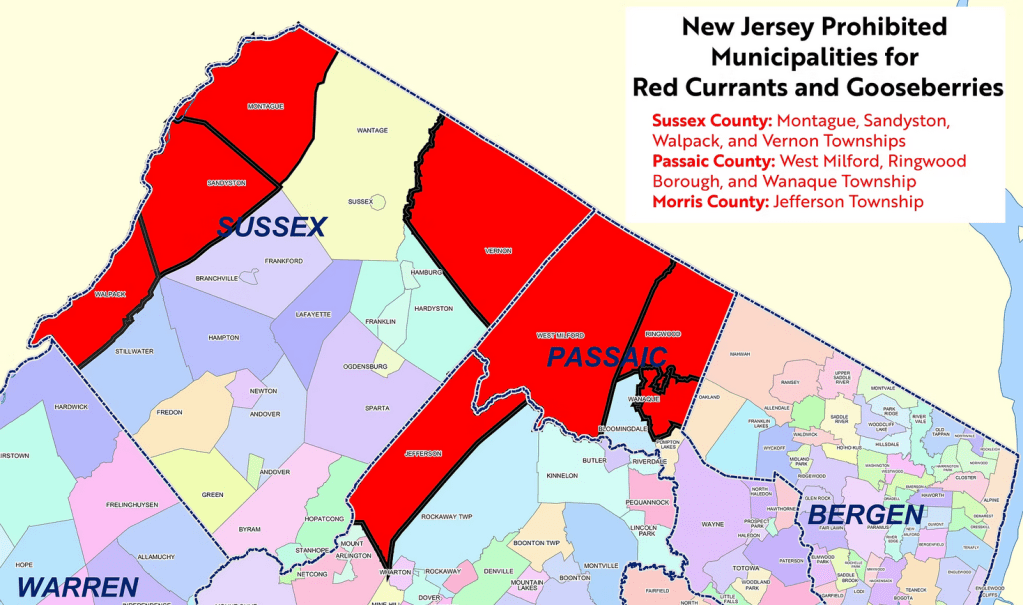
If you live in a state other than PA/NJ, you may want to check the laws and restrictons on growing currants where you live.
Got a bigger vision in mind? Let’s zoom out together and design your garden.
 Hundred Fruit Farm